Showing posts with label Premier League. Show all posts

Thursday, 26 March 2015

Qatar's winter debacle might prove a tonic for the Premier League

As FIFA's Qatar World Cup Final gets set for Christmas week, perhaps our shock horror reaction at the disruption, set in winter stone for 150 years, may thaw after all?

How many times have England fans lamented our biannual failure because Rooney & Co were too pooped from the rigours of a 60-game season?

How much of a chorus has there been for a winter break after Boxing Day to give players the vital rest required?
Sportsmedia's dream for the Golden Generation
Every other year, that’s how much! But the chorus can’t be ignored forever.

So this enforced abruption could prove the blueprint for future Premier League seasons if our disparate interest groups can unify.

And as English clubs wither in the Champions League, perhaps a winter break might aid performance.

Richard Scudamore and his member Premier League clubs usually display a lack of will to embrace change in the face of external influences – but FIFA edicts are too big even for them to resist.

Maybe now, they’ll act on the relative benefits to keep the winter break into season 2022/23.

Don't hold your breath, mind - it might freeze!

Tuesday, 10 March 2015

It's all about Premier League survival for Villa, says BBC Radio 5Live's Phil Williams

After a dramatic FA Cup weekend, it's time for an emotional reset! That's the view of Phil Williams, who's supported Aston Villa since his childhood growing up in Birmingham.

It's Phil Williams!
The BBC Radio 5Live presenter, on-air weekday evenings from 10.30, says the league game at Sunderland is more important than the FA Cup, because staying in the top-flight is key to the club's future.

And fans need to park the heightened euphoria of double victory over the Baggies - and concentrate on the dogfight.

Here's Phil in conversation with me recorded before the FA Cup win.

Thursday, 5 March 2015

It's Howard and Jonny's Albion Sandwich!

In between the two make-or-break fixtures with our nearest rivals, Howard and Jonny discuss the nervy last-gasp win over the Albion (nothing jittery about Benteke's composed penalty mind) - and why Gaby Agbonlahor might be the biggest winner in the Tim Sherwood era.

There's predictions for Saturday's FA Cup quarter-final as Albion return - and a surprise reaction from Villa fans about which Albion game was more important, in the league or the cup?


Monday, 4 November 2013

Dyke's FA Commission is a consequence of his entire career.

Here's Marcus Stead's fascinating chronicle on the formation of the Premier League. Greg Dyke's pivotal role in it and the FA Commission, which is a consequence of its runaway success. 

When the new FA chairman Greg Dyke announced his masterplan for England to win the World Cup in 2022, he effectively admitted what we’ve all known for years: The FA and the Premier League have wholly different objectives.

The priority of Premier League clubs is, depending on their status, to win the league, qualify for Europe, or avoid relegation. Developing a pool of players for England selection doesn’t really feature in their plans at all. 

What isn’t so well-known is the enormous role Dyke played in the creation of the Premier League in the early 1990s. He didn’t realise it at the time, but he created the monster that is now standing in the way of the England team’s development. 

There are plenty of reasons to welcome Dyke’s appointment as chairman, and his CV makes for interesting reading. He is a man who was nothing special at school, and left with just one A-level, a grade E in combined mathematics. Even this came as a surprise. Dyke’s 20s were largely frustrating and unrewarding years and it was only at the age of 30, when his life hit rock bottom, that he took his first job in television, as a lowly researcher at LWT. 

His drive, enthusiasm and intelligence saw him rise rapidly through the ranks, and within a few short years he was in charge of ‘The Six O’Clock Show’, one of LWT’s flagship programmes inside London. It wasn’t long before Dyke was appointed Director of Programming at ailing breakfast station TV-AM, where his populist touch helped transform its fortunes following a disastrous start. From there he became Director of Programmes at TVS. 

After a few years, he was back at LWT in the same role, which, under the rather complex ITV structure at the time, included the title Chairman of ITV Sport. 

Dyke understood that society, and indeed the television landscape, was changing rapidly. He realised that he needed to move away from general magazine sports programmes and instead focus on live events. He also wanted to take ITV Sport upmarket, along with other areas of the channel’s output. 

British wrestling was dropped, and the money saved was invested in boxing. Also for the chop were darts, bowls and gymnastics, which saved him around £1.5 million per year. Live football was pivotal to his strategy, however, he rightly realised that the days of the BBC and ITV effectively operating a cartel were coming to an end. Dyke knew that the new pay TV satellite broadcaster, BSB, was keen to grab the rights to live top-flight football, and was willing to pay far more than the BBC and ITV had done under previous deals. 

BSB had already been networking with the Football League with a view to obtaining the rights, and Dyke had to come up with a strategy. Dyke sought advice from Trevor East, the Deputy Head of Sport at Thames Television, who was a football specialist, having previously been a board member at his beloved Derby County, and a canny operator. 

Dyke asked East who he could talk to ‘off the record’ and he suggested David Dein, the Deputy Chairman of Arsenal and a member of the Football League management committee. The three of them met at a Japanese restaurant, where Dyke and Dein struck up a close friendship that lasts to this day. Both sides had something to gain from this arrangement. Dein’s view was very clear: The viewing public wanted to watch the big clubs, so those clubs should get the bulk of the TV money, which, until that point, had been split between the 92 league clubs. 

The three of them came up with a plan. They would go directly to the big five clubs of the day – Arsenal, Liverpool, Manchester United, Tottenham Hotspur and Everton, and offer them a million pounds a year for the exclusive rights to broadcast their home matches. To put things into perspective, the previous deal was worth £3.1 million a year in total, half of which was spread equally between the First Division clubs, with the rest going to clubs in the lower divisions. Certain factors helped Dyke’s cause, such as the fact that Philip Carter of Everton was Chairman of the Football League at the time. 

Dyke took John Bromley, the late Head of Sport at ITV and technically his superior to the first of a series of meetings, but Bromley was uneasy about a side deal being done, so Dyke simply didn’t invite him to future meetings. At the second meeting, they decided to extend the initial group of five to include five more clubs who would receive a lesser amount, but still substantially more than they received under previous deals: West Ham, Newcastle United, Aston Villa, Nottingham Forest, and Sheffield Wednesday. Dyke’s logic was that with these ten clubs on board, dubbed the ITV Superleague, the Football League could then sell the rights to the rest of the league to BSB, or whoever they liked, but without the big clubs, these rights wouldn’t be worth much. 

In response, Football League officials obtained a High Court injunction preventing the ‘big ten’ from signing a separate contract with ITV. BSB, by now operating a joint bid with the BBC, upped its offer, and so did Dyke, encouraged by Dein. BSB and the BBC later withdrew amid angry outbursts of ‘negotiation by auction'. 

Dyke and ITV had won. They reached an agreement to pay the Football League £11 million for 21 live matches, largely from Division One but also including the latter stages of the League Cup, to be broadcast mostly on Sunday afternoons. Meanwhile, BSB and the BBC did a deal with the FA for the rights to the FA Cup and England internationals, but the reality was that for the next four years, there would be no Match of the Day on Saturday nights, except on FA Cup weekends. By the standards of the time, ITV’s coverage, branded ‘The Match’ was innovative and exciting, with computer graphics and more cameras in the ground than before. However, by the standards of today, it would be considered second rate. 

The contract permitted far fewer live matches than there were rounds of fixtures. They had unlimited access to highlights, with a great deal more flexibility than broadcasters have today, but they chose not to use them at network level. Some ITV regions, especially Granada and Yorkshire, showed fairly regular Saturday evening or Sunday lunchtime highlights of the teams in their areas, but viewers in regions with no top flight teams went without highlights at all. 

The goals from the First Division were usually crammed into the half-time interval of the Sunday live match, or shown on Saint and Greavsie the following Saturday lunchtime. What’s more, ‘The Match’ only came on air five minutes before kick-off and they didn’t hang around for too long after the final whistle, because it would be time for ‘Bullseye’. 

Typically, there would be no coverage of the first few weeks of the season, and one year they didn’t bother at all until the clocks went back at the end of October, as Dyke claimed that people would be in their gardens on Sunday afternoons until then. It would be harsh to judge Dyke on these shortcomings. Football was in the doldrums during this period, and it’s worth remembering that the BBC had suspended regular Saturday night highlights not long beforehand, and put NBA basketball on in its place. In comparison to what had gone before, Dyke and ‘The Match’ were a force for good. 

There were enormous ramifications from this deal within the Football League. The lower league clubs were angry that they’d been cut out of the new deal and took steps that would later do them no favours. They got together and removed Phil Carter as the League’s Chairman and forced David Dein off the management committee This was a real game changer for when the rights next came up for renewal. 

By the autumn of 1991, it was time for Dyke and East to start thinking about a new deal. They contacted Dein, and arranged a dinner for the ‘big five’ clubs, to be hosted by Dyke in the hospitality suite on the 18th floor of the LWT building on London’s South Bank. 

Most of the people present were the same as four years earlier, and unsurprisingly, Dyke and Dein had discussed tactics in advance. Dyke opened by saying that he thought it unlikely that they could do another deal with the Football League negotiators that would be as favourable to the big clubs as the last one. He was undoubtedly right about that. 

Dyke told them that they had a choice: take less money, because the total was going to be spread between more clubs, or take radical action and break away from the Football League. 

This was a no-brainer for those present. They all resented the way Carter and Dein had been treated by the Football League, and supported the breakaway. Greg Dyke had effectively created the Premier League. Things moved very quickly in the months that followed. The chairmen agreed that if they were to succeed, they needed to get the FA on side. 

There was no love lost between the FA and the Football League in those days, therefore doing this wasn’t especially difficult. There was just one problem: By this stage, BSB had merged with Sky to form BSkyB, and ITV would be up against Rupert Murdoch and his money as they bid for the rights. East warned Dyke not to be complacent. 

Having the ‘big five’ on board wasn’t enough, and he needed to spend more time talking to the smaller top flight clubs. Dyke didn’t take East seriously enough. He wasn’t the sort of man who enjoyed making polite small talk in a bid to get people on side. He thought that because his strategy of having the ‘big five’ on board had worked four years earlier, it would work again. He had underestimated the sheer scale of Murdoch’s ambitions, or the depth of his pockets. 

Dyke had lunch at Langan’s with Sam Chisholm, the brash, mouthy Chief Executive of BSkyB, a New Zealander who was admired and loathed in equal measure. Murdoch had brought him in to save the company, and Chisholm claimed that what he was about to say to Dyke had come from the man himself. 

Using some rather crude language, Chisholm suggested that he and Dyke get together and share the rights to the new Premier League, to keep one another’s bidding costs down if nothing else. Dyke laughed at Chisholm’s suggestion, and in doing so had made a vital miscalculation. He assumed that Chisholm’s offer to work together was a sign of weakness on BSkyB’s part, and that ITV was in prime position to claim exclusivity as a result. How wrong he was. Chisholm went to Will Wyatt, the managing director of BBC Television, and suggested a partnership – the BBC’s respectability and BSkyB’s money, to give Sky exclusive live rights and the return of weekly highlights on the BBC. 

The BBC offered around £20 million per year, on the condition that ITV didn’t get live rights. Wyatt was acting with the blessing of the late BBC Chairman Marmaduke Hussey, a former chairman of Times Newspapers who knew Murdoch well, and had already discussed the issue with him. Hussey had certainly gone well outside his remit as BBC Chairman in discussing football contracts in the first place, but it wouldn’t be long before all sides were bending the rules as bidding for the ‘big prize’ became more aggressive. 

Crucially, around this time Irving Scholar had sold Spurs to Alan Sugar, whose Amstrad firm was the sole manufacturer of Sky’s dishes in those days. Scholar was an ITV man, and for obvious reasons, Sugar was in the BSkyB camp. 

Some time earlier, Rick Parry, the Premier League’s Chief Executive, had shaken hands with East at a boxing match, informally agreeing a deal which would lead to ITV getting the contract. 

In the intervening period, Parry had been heavily courted by all sides. Parry then insisted on a proper tendering process, where broadcasters would submit their best and final bids by a certain time, and the merits of each bid would be discussed at the meeting of the chairmen within a matter of days. 

In the intervening period, Dyke received intelligence from the Premier League that he was in danger of losing. The rules had been broken, and the gloves were off. Dyke and East worked all through the Sunday night before the meeting at the Royal Lancaster Hotel the following day. They hit the clubs with a new offer, which East delivered personally to each club representative. A few minutes after the meeting started, Sugar came rushing out of the meeting and made a call to Chisholm from a public phone cubicle, and East overheard him say ‘You’ve got to blow them out of the water’. 

What Sugar didn’t know at the time is that Parry had already made Chisholm aware of the offer. Chisholm got the message that he didn’t need to just offer a million pounds more than ITV, it needed to be considerably bigger, and beyond the reach of their competitors. Sure enough, a new bid from BSkyB arrived. The BSkyB/BBC bid saw BSkyB pay £190 million for five years for exclusive live rights, with the BBC paying around £100 million over the same period for highlights. 

Dyke was deeply unhappy with the nature of BBC’s involvement in the deal, which he thought was a consequence of Murdoch’s close relationship with Hussey. What’s more, without the BBC’s money, ITV’s bid was higher. 

As the meeting of chairman convened, Sugar, to his credit, declared his conflict of interests, and suggested that he should abstain from the vote. Although David Dein and Martin Edwards of Manchester United agreed that Sugar should abstain, most of the smaller clubs believed he should be allowed to vote. 

In other words, Dyke hadn’t done enough to try to get them on side, and he should have taken greater notice of East’s earlier warning. It has often been said that Sugar’s vote was crucial in swinging the contract ITV’s way, but this isn’t entirely true. 

The chairman of Nottingham Forest had promised to support ITV, but he had sent his office secretary to the meeting on his behalf, because no one else was available. That vote in favour of BSkyB/BBC turned out to be crucial, and the contract was theirs. 

A subsequent High Court challenge by ITV came to nothing. This whole process leaves is with plenty of ‘what ifs’: What if Dyke had taken East’s warning more seriously and had done more to get the smaller Premier League clubs on side? What if Dyke had taken advantage of his meeting with Chisholm and they’d come to an arrangement where ITV and BSkyB could share rights? What if the Nottingham Forest chairman had turned up and the vote had swung ITV’s way regardless? 

We will never know the answer for sure. Premier League football was, and still is, BSkyB’s flagship product. Chisholm insists the company would have survived without it, albeit with some difficulty. Plenty of others disagreed. Murdoch had taken a massive gamble by setting up BSkyB, and it’s quite possible its failure would have had wider ramifications for his media empire. 

Or maybe not. 

If BSkyB had sunk, would Premier League rights be sold for the kind of sums they are today? Actually, I suspect they probably would, as the likes of Al Jazeera or the Disney-backed ESPN would have made a substantial entry into the UK market, and in terms of money and the overall level of coverage, we would be more-or-less where we are now, although it’s possible one live match per week would still be shown on free-to-air TV. 

What is indisputable is Dyke’s enormous role in creating the Premier League in the first place. Now, more than 20 years later, this has come back to haunt him. He created a monster he cannot destroy. 

Make no mistake, bringing players through for England selection is not a priority for any Premier League club. When signing players, they act in their own best interests. It is as simple as that. They feel no emotional or moral obligation to make Greg Dyke or Roy Hodgson’s lives any easier, or to help England win the World Cup. 

At his recent news conference, Dyke’s reputation as a straight-talker took a bit of a battering with his use of meaningless business clichés such as ‘going forward’ (you can’t plan for the past, Mr Dyke!). He also referred to ‘challenges’ whereas a real straight-talker would have said ‘problems’, when referring to foreign players blocking the playing opportunities for English youngsters. 

During the press conference, Dyke announced that he was setting up and chairing an FA Commission that would ask three simple questions: 

1. Why has this happened?
2. What could be done about it? 
3. How, if possible, can these changes actually be made? 

We all know the answer to question one, but Dyke hits a major stumbling block with his second and third questions. 

There is no point whatsoever in placing a restriction on the number of foreign players in any squad for as long as Britain is in the European Union. One of the key principles of EU membership is the free movement of citizens throughout the union to live and work. 

For his entire adult life, Dyke has belonged to, and supported organisations that believe in Britain’s continued membership of the EU. He was a member of the Labour Party for decades, and, at various times, was a close associate of senior europhile members of the New Labour project, including Tony Blair and Peter Mandelson. 

When he fell out with New Labour over the Hutton Report, he soon joined the even more pro-EU Liberal Democrats. He even donated £10,000 to the party to help them fight the 2005 general election. During his time as Director General of the BBC, he did absolutely nothing to put right the institutional pro-EU bias that shone through on their TV and radio bulletins, something his successor, Mark Thompson, eventually admitted was a problem that needed addressing. 

Unless Dyke or anybody else is willing to advocate Britain’s withdrawal from the EU, the debate about limiting non-English players is utterly futile. I suspect he already knows this. 

The other thing Dyke really needs to grasp is that this horse has already well and truly bolted. Just seven of the 20 Premier League clubs are English-owned. Only four of the managers are English. Even if a club is English-owned and English-managed, their priority is the club’s progress, not that of the England team. Let’s just imagine for a moment that Dyke has a massive change of heart and spearheads a successful campaign to get Britain out of the EU. Does he really imagine that all the Premier League club owners and managers will then sit around a table with him and devise a meaningful strategy to help England win the 2022 World Cup? It is far, far too late to do anything about this. 

The Commission is due to report in early 2014, and I’m willing to hazard a guess at what its conclusions will be: 

There is a lack of qualified coaches at youth level; the quality of football coaching in schools is unacceptably low; there is too much emphasis on winning matches and too little on developing skills with children; clubs are too quick to dismiss English youngsters from their academies; children in this country spend far too little time playing football with their mates these days, due to cultural changes over the last 30 years or so. 

All this is very true, but the questions I have asked are far bigger. The Premier League is Greg Dyke’s Frankenstein. It was largely his creation, and now the beast is completely beyond his control. 

Tuesday, 29 January 2013

Drogba's back in Europe and the Government meddle in our national game!

Premier League vs Public Sector!
Could the Premier League fall victim to Government fiddling?

Good Morning football fans!

So many on and off-field stories to chew over this morning.

Galatasaray are back in the transfer market ahead of their Champions League last sixteen tie with Schalke... they've only gone and signed Chelsea's Champions League legend, Didier Drogba! Jonny asks if the Turks are a good punt to win the European Cup, having already signed Wesley Sneijder.

There's more transfers in the Premier League as the transfer deadline counts down as West Ham strengthen - but Villa weaken... (I'm sending the begging bowl round for our billionaire chairman!)

There are four top flight fixtures tonight plus Beckham's Arsenal chance, but is it more than just training?


Wednesday, 16 January 2013

Pep talk on Premier League was a Bayern bluff

Pep Guardiola’s near-theatrical “I want to manage in the Premier League” gush turned out to be the most elaborate "come and get me plea" in the electronic media age.
Pep flirted with England's elite - then signed for Bayern!
The former Barcelona boss, on sabbatical after stepping down at Camp Nou last season said, "As a player I couldn't realise my dream to play in England. But I hope in the future, I have a challenge to be a coach or a manager there."

He added: "It is unique to play in that league. I want to feel the supporters, the environment, the media and the style of the players and everything.

But in the very same day as those words were trumpeted through press and social media, Guardiola agreed terms with German giants, Bayern Munich. So much for feeling the English game then.

Pep guided the Catalan giants to an incredible haul of 14 trophies in four seasons. Auf wiedersehen, Pep!

Then again, Bayern's a prudent and sober choice for someone of Pep's experience and calibre because they resemble his old club, Barcelona in many ways:

Bayern is 82% owned by the fans in a setup similar to that of the Catalan giants and like Barca, they're one of the big two clubs at home.

They also have an enviable youth policy and a desire from the cream of the crop to play for them. It's a hunger shared by just a handful of the world's top clubs.

They're also perennial and viable Champions League performers and sign players from other domestic clubs.

All of these similarities will aid Guardiola to repeat his stellar achievements in the Bundesliga and beyond.

He's spent time away with his family in New York, sampling life and culture in a completely new environment. Despite the growth of the MLS, Manhattan remains one city where Pep can remain almost anonymous in the crowd.

But in signing for the Bavarians, he's ready to step back into the limelight.

Meanwhile, we all know what Jose thinks of English football. The ex-Chelsea boss has a long-held desire to return to these shores when his time at Real Madrid comes to an end.
Jose is open to an English return
England and Spain have been vying toe to toe to be regarded as the best league in the world for the last decade. Perhaps Spain have nosed ahead the last couple of seasons if the FIFA Ballon d’Or awards are a barometer.

But I believe English football is about enter another golden era. Television rights in this country are up 70% from next season – which means while wages are being controlled for lesser talent, English clubs will be able to top dollar and premium for real (or perhaps Real) talent.

Don’t be surprised if the brain drain of managers to England isn’t matched by Latin stars choosing Wigan on a wet Wednesday night too.

Germany's grabbed a superstar coach - but while the Bundesliga's among the most competitive of European leagues, only England has the financial clout to attract a basket of top names.

You heard it here first: English club football is about to enter a period of renewed dominance - and will leave even Spain - and Germany in its wake.

Friday, 13 July 2012

The 39th Game: the debate rages again

As Manchester United jet across the world satisfying a Premier League hunger beyond these shores, the spectre of a 39th Game must surely be back on the agenda.

United lead the way with a mind-numbing pre-season schedule of 22,000 airmiles with friendlies in South Africa, China, Norway, Sweden and Germany.

Premier League CEO Scudamore loves globalization
Champions Manchester City travel 16,000 miles to Austria and China. Everton are in Indonesia, while Spurs, Chelsea, Liverpool and Villa are in the USA.

Chief Executive of the Premier League, Richard Scudamore is the most powerful proponent of globalising the Premier League with the 39th Game, but it's an idea in the traditions of Millwall. No one likes it, he don't care!

And when I canvas my fellow football-loving pals, I'm firmly in a minority of one in thinking this is a good idea.

But it's got to be a logical progression for the most widely watched league in the world.

Supporter groups in England are unsurprisingly against it.
After all, the NBA and NFL come to London, so is the Premier League missing a trick? In an inter connected world, isn't it an essential mechanic of a global game?

And if we don't do it, won't other European leagues biting at our heels do it first? Barcelona and Real Madrid are real Box Office and oh yeah, their national team is the greatest ever! The Premier League must stay ahead of the game and embrace an enlarged and growing fanbase - or somewhere else will grab them.

As the recession showed, travelling support for England was curtailed to Poland and the Ukraine, but for clubs like Manchester United and Liverpool, local support is literally only half the story.

And for teams like Queen's Park Rangers, boasting new signing Ji Sung Park, South Korea presents a massive new fanbase opportunity (although curiously his homeland isn't part of their mammoth 20,000 mile trek this time).

I really believe it's one-eyed for the Premier League not to consider the 39th Game and having created the global demand, our clubs need to respect and honour it with meaningful competition, not just friendlies.

We had an audio debate in the @sportsmediauk newsroom - and Marcus Stead wrote this passionate piece against it.

Click here for the current Top Story Soccermongery's all about your feedback, so write away, right away!

Thursday, 15 March 2012

How the mouthy have fallen! The week in football

Turns out WBA did for both of them!
You'd be forgiven for thinking Arsenal's team was made up of eleven Englishmen after their heroic failure to reach the last eight of the Champions League the previous week. So it was left to Chelsea to fly the flag for the Premier League.

Up a slightly less steep hill than the Gunners but nevertheless still in a tight spot, Chelsea completed a remarkable fightback to overturn a 3-1 first leg deficit to win 4-1 over Napoli in extra time at the Bridge.

Since taking the reigns from the deposed Andre Villas Boas, caretaker Roberto di Matteo's galvanised the Blues and critically, it's been the Chelsea pensioners of Terry, Lampard and Drogba who steered them to glory with a goal apiece.

This poses a problem for the next Chelsea boss because even though the thirtysomething trio can still do it at the highest level, ultimately they need replacing. Like Villas-Boas tried before, the new man will have to grasp the nettle. 
Paternity leave beckons
But it should be Di Matteo: he's no ordinary stand-in coach even if he's not Roman Abramovich’s first choice. There’s been grandiose talk of a Mourinho return, Fabio Capello (he who stood down over John Terry), and even Pep Guardiola.

But for me Roby's the man: for a starter, he’s a Chelsea ledge. Scorer of famous goals in Cup Finals and more than served his apprenticeship as an English club manager, and you just can't create that exuberant celebration after beating Napoli that showed he cares so much for the club and the group of players.

He almost gave Fernando Torres whiplash, jumping on the Spaniard from just outside his peripheral vision. If he's overlooked in favour of a bigger star, then Roman’s Empire may just continue to go round in circles.

Special mention for Steven Gerrard: on his 400th appearance for Liverpool, he thumped a hat-trrick to flatten neighbours Everton which also marked David Moyes' decade in charge at Goodison. Moyes has guaranteed the Mersey Blues have continually punched above their weight, but this time it's back to the drawing board for those soft-centred Toffees!

The expectation at Anfield is unbearable. History is a huge burden on the back of this current crop especially as manager Kenny Dalglish was responsible for so much of it. How quickly the League Cup win's been forgotten. It's the Champions League that matters.

Meanwhile, if you're in need of entertainment at your football conference, look no further than Dave Richards after a day of embarrassment for the Premier League chairman.

I can’t believe Richards apologised for being a Yorkshireman for what he called his “broad comments” during a speech in Qatar.

What a complete dill!
Richards said, "England gave the world football. It gave the best legacy anyone could give. We gave them the game. We were its governance. We wrote the rules, designed the pitches and everything else. Then 50 years later some guy came along and said you're liars and they actually stole it. It was called Fifa. Fifty years later, another gang came along called Uefa and stole a bit more."

Even the Premier League distanced themselves from their chairman's comments, claiming the old boy wasn't in Qatar in an official capacity.

But event organisers didn’t need to pour cold water on Richards. He did that himself later by falling into a fountain during a trip round a museum! It’s lucky he was helped back to his feet in doublequick time as he might have been mistaken for one of the relics.

Taxi for Richards!

Monday, 8 August 2011

Football's forgotten it's in the "selling dreams" business

So the new Premier League season's a matter of days away and while collecting some thoughts on the title race, it's dawned on me that even the most casual observer could probably set out a league table resembling the reality of next May.

It's so predictable, isn't it? For anyone but three teams, winning the league is beyond dreams and for the rest, ambition falls into narrow categories of finishing higher than before, being top in October, not being relegated - or going on a cup run.

Even the Community Shield steeplechase presented a microcosm of the season ahead. Bold, big-spending Manchester City raced into a two-nil half-time lead against Manchester United, before succumbing to the Champions in a shocking case of believing their own hype before the game had finished.

And so the usual protagonists will be "there or thereabouts come the end of the season", leaving the rest of us to delude ourselves about how we might've challenged "higher up".

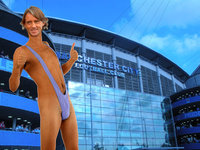
It's just business, right? a kind of new commercial warfare. If you're up against the likes of Fergie, Abramovich and Abu Dhabi Babby, there are significant barriers to entry. It's about the money. honey.
Roberto Mankini
And if football is only a business, then let me cloak this in terms a businessperson might understand:

There's a conflict of interest with your customer-base.

As fans, we believe in dreams.... and it's just not good enough to present football as a "lifestyle choice". Who wants to traipse around the country watching your plucky team draw and finish 9th?

Because if football is just a lifestyle choice, then people will begin choosing other things to do. Football had better watch its back.

Meanwhile as if to prove my point about predictability, see how close this is to the final reckoning at the end of the season:

You need shades in Smethwick, Roy.

1. Manchester United
2. Chelsea
3. Manchester City
4. Arsenal
5. Liverpool
6. Tottenham Hotspur
7. Aston Villa
8. Fulham
Bloody 'ell
9. Everton
10. Stoke City
11. Ravioli
12. Chunky Chips
13. Blah Blah

Fergie says: "Leave your predictions in the Comments Section below".
Click here for the current Top Story

Saturday, 5 March 2011

Football needs to punish its miscreant stars

Graham Norton gets to grips
The BBC's Graham Norton Show isn't normally the platform to gauge public opinion on football, but the instant reaction of his studio audience should send alarm bells ringing at the Premier League.

Norton's routine covered Ashley Cole, who took an air rifle into training at Cobham which he not only used, but actually shot someone with. Norton's fans booed Cole on two separate occasions, taking the entertainer by surprise.
Ashley Cole's story in The Super Soaraway
Obviously with a big midweek game against Manchester United just days away, Chelsea took no action. But neither did the Premier League or the FA. A case of the Three Monkeys if you ask me.

United also faced no censure as Wayne Rooney crunched Wigan's James McCarthy with his elbow.

Sir Alex Ferguson conceded Rooney had been "a lucky boy" not to be sent off, but the only swift reaction we got from football's authorities was the England striker was to face no punishment.

See no evil, Hear no evil, Speak no evil

Football claims to be a cradle of English culture and values. The FA have run campaigns with titles such as Respect and Get Into Football. But its ideals will soon be regarded as hollow if it doesn't take even the smallest stands against its biggest miscreant stars.

Sponsorship and TV revenue keeps rolling in - but investment from corporations isn't just reliant on ratings. They're also badging a product and if it's perceived to have diminishing morals, then football will lose its financial value.

Sky took a stand against sexism with the resignation of Richard Keys and the sacking of Andy Gray. That sets the tone for a repositioned morality and style to football from here on in.

Rooney: The 4th Monkey

Football, TV and sponsors need each other in equal proportion. It appears in these days of ecomonic austerity, there isn't one stakeholder which is any more powerful than another.

The FA would have been surprised by the public's positive reaction had they had the guts to punish Cole and Rooney. Graham Norton would bear witness to that.

It's nearly twenty years since the formation of the Premier League. It's never been more successful, but it's probably never been more complacent either.

Click here for the current Top Story Soccermongery's all about your feedback, so write away, right away!

Sunday, 23 May 2010

Mourinho Premier League return would break the Golden Rule

One finger for Chelsea, the other for Barca!
As Jose Mourinho outfoxes Pep Guardiola, Carlo Ancelotti and Louis van Gaal to record a stunning Champions League victory, rumours of a Premier League return intensify. Luckily for the Portugeezer, the clamour from Real Madrid is louder. But Soccermongery warns against him coming back to England. 

We still hear a lot about The Special One over here. Our obsession never cooled despite a raft of new heroes and headlines created since.

Despite leaving England two-and-a-half years ago, Mourinho's life at Inter is well chronicled by our media.
His rows with Italian officialdom and managerial peers, his dissatisfaction with Serie A and his rumoured desire to return here one day. His raffish Portuguese style galvanised Chelsea to previously unchartered waters of success. But now the Inter project is complete with a stunning treble, it's widely rumoured he'll be managing at the Bernabeu, the scene of arguably his greatest triumph as a coach so far. 
Kenneth Williams
But English clubs big enough to support both The Special One's salary and his ego would probably shuffle their incumbent manager out the door just to secure him.
You could well imagine United, City - or even Liverpool with new ownership encouraging Jose back "home".
But what a mistake that would be! "Never Go Back", screams the old adage.

Mourinho's remembering his time at Chelsea through rose-tinted spectacles. He arrived at Stamford Bridge, all posturing and bravado crowned as European Champion with Porto.

The hottest property in the world game, he gave Roman Abramovich's billion pound project real focus. Six trophies in three astounding seasons followed.

But that was then. This is now.

English football, built on huge debt or the billions of a benefactor totally dominated the European game. But the tide is turning. Not only is UEFA kicking the English game when it's down - but Britain's desperate Labour government were killing the goose that laid the golden egg.

English clubs pay more tax than their Spanish counterparts - the players too are feeling the tax pinch. Already the trickle of foreign stars coming to England is diminishing. Spain and Germany are more favoured destinations. It costs more for an English club to sign and pay for an international star.

Cristiano Ronaldo's defection from Manchester United to Real Madrid may prove symbolic - unless the Premier League can really focus on exploiting emerging new markets such as the Far East and India.

Mourinho would return to a less mighty English game. That's why talk of taking over at Real would be a better port of call for him. But could the sheer force of his personality or Manchester City's millions buck the trend?

Click here for Avram Grant, football's most celebrated loser and The full-length Nike World Cup advert in HD.

Soccermongery's all about your feedback, so write away, right away!

Sunday, 9 May 2010

Burnley's Fair Play League hopes dashed

As quickly as hopes were raised for Burnley, they were dashed! UEFA's decided to award Fair Play places in Europe to Sweden, Denmark and Finland next term, so ending the relegated Clarets hopes of joining the Euro elite from August. But Soccermongery says the Fair Play League is distinctly unfair - to deserving clubs:

Why should Burnley manager Brian Laws have been incentivised by Europe's governing body to send out his team urging careful challenges in their last game of the Premier League season? Because that's what Laws would've been mindful of as he prepared his Clarets for their last (ever) game in the top flight, at home to Tottenham. A place in Europe via this contorted route was still up for grabs at the time.

It’s not as if they were a particularly clean team anyway. Burnley were just the highest up the Fair Play table who'd not qualified for Europe.

In fact, they finished as low as seventh. Incredibly, the six teams above them didn’t need a back door to Europe like this; they'd already qualified. Arsenal, Spurs, Chelsea and Villa among them.

What the Fair Play League shows year after year is that successful teams are usually disciplined enough to play the game the right way, leaving struggling hoofers like Burnley to earn this ridiculous route into the Europa League.

I suppose it might've stopped an exodus of players from Turf Moor following their relegation to the Championship. That and the parachute money, of course. But it’s still a European-style fudge and nonsense.

If UEFA awarded a Europa place to the most improved side in the Premier League, it might help that club to develop further. Stoke or Birmingham would drink to that suggestion.

Tuesday, 6 April 2010

Fergie's missed his chance to quit at the top

As Chelsea turn the title race around, United succumb to German efficiency in Europe. Are United prone to mistakes in their haste to win matches? Is Fergie reaching for the pipe and slippers under the weight of the Glazer's debt bubble? Jonny's view:

It was all set fair: Rome, May 2009. A second consecutive Champions League Final. Victory over Barcelona would've confirmed Manchester United as the undisputed greatest on the planet. Well, they'd already mopped up a hattrick of Premier League crowns and claimed the first-ever meaningful World Club Cup.
A third European title beckoned for Sir Alex Ferguson and having drawn level on eighteen with Liverpool as Champions of England, Fergie had fulfilled his promise of "knocking the Reds off their perch".

But Barca outplayed United. With 150 goals and six titles to their name, Messrs. Messi, Henry and Eto'o flicked mud at United's glister.
Then with Cristiano Ronaldo's defection to Madrid confirming Spain's economic and footballing superiority over England, Fergie might've wished for one more heroic 90 minute push from his never-say-die troops against Barca.
That way he could've left: unbowed, undefeated, the Greatest Of All Time.
But his boys lost badly - and like Muhammad Ali, the street fighter doesn't know when to stop.
Eleven months on, Bayern Munich have put paid to United's European bid at quarter-final stage and Chelsea have turned the title race upside down just as United were closing in. They look beatable by a dozen teams in the Premier League: emerging Villa emphatically planted their victory flag in Old Trafford soil, followed up by the ignominy of losing at home to Leeds United, two divisions below them.

Far from being the man in control, the hairdryer has a lower voltage. Sentiment's playing a role in some of his selections.
That the much-decorated Ryan Giggs and Paul Scholes are still figuring isn't the Fergie of five years ago. No, back then they would've been on the Slow Boats to Everton, Newcastle and alike.
As much as Giggs still plays well, realistically he's not even a player that Spurs, Villa or Man City would race to sign. Scholes? wonderful servant but nowhere near the level required.
At the back, their squad's threadbare. Were Carrick and Fletcher really used as makeshift defenders? suddenly United's squad seemed no deeper than Stoke or Bolton's.
So the Govanator's missed his chance to quit at the very, very pinnacle of the game - or has he?
There's one way he can bow out with head held high. To go hell for leather for the Premier League title. A fourth consecutive trophy in the Old Trafford cabinet and a nineteenth in all to surpass Liverpool, would mark Fergie as the King of Kings in management. But after Chelsea, it's a Big If.

Tuesday, 16 March 2010

Rooney leaving United? No chance!

As Wayne Rooney's stature in the world game grows, the tabloids are screaming! Manchester United must offload their main man under the weight of a billion dollar debt. Rooney's goals in the San Siro and Old Trafford against AC Milan flag him up as a diamond of the first water.
For Sale to Barca or Madrid at £90million?
United need to service their £715m loan; the Glazers, having whipped twenty million out of the club are restructuring the biggest red balance sheet in football history - just to keep the behemoth afloat.
But the cock-eyed rumour mill fails to factor in the most important pillar at Old Trafford; the manager, Sir Alex Ferguson.
Not while Fergie's at the club will Rooney leave United. Madrid and Barca have two hopes of capturing Wazza: no hope and Bob Hope while the Govanator's in charge. And he is in charge.
And oh yes, United are fighting for the Premier League title, Carling Cup winners - and desite the shock of losing to Bayern Munich in the Champions League, still did for Milan. A 7-2  aggregate mauling. Does a certain Mark Twain phrase of overstated demises spring to mind?
If Wazza leaves while Sir Alex is in charge, you can be sure the Ravens will have also left the Tower. For it would demonstrate the wave of financial misfortune had swept over the Fergie Empire - and washed it away in a startlingly brutal consequence of the Credit Crunch.

No no no, Fergie is the King Canute of Football's Credit Crunch and Wayne Rooney, once a Blue, is now very much a Red.

Click here: The Champions League has less competitive integrity than the Premier League


Soccermongery's all about your feedback, so write away, right away!

Thursday, 4 February 2010

SOCCERMONGERY EXCLUSIVE! Avram Grant's shoe collection!

We've a first picture of Avram Grant's shoe collection! These brothel creepers are de rigeur on the south coast, according to Soccermongery's Fashion Correspondent!

There's little doubt Portsmouth have improved since Avram Grant replaced Paul Hart as manager, but the truth is they're too far adrift for anyone to save them from relegation - let alone Grant.
Pompey slipped to yet another Premier League defeat, 1-nil at Fulham despite playing the better football. But they failed to take their chances and even though Jonathan Greening's Fulham winner had a hint of offside, if ye dunnae score, ye dunnae win!
Avram's Portsmouth put in a good shift. They've a good work ethic, but lack that essential quality to turn their chances into regular points.

Despite languishing at the bottom of the table, Portsmouth still attract headlines beyond the pitch. Hong Kong businessman Balram Chainrai's become the club's fourth owner of the season and the Pompey boss himself was outed as the Premier League boss caught in a brothel.
There's a case for Grant to be sacked for this indiscretion alone, quite aside from Portsmouth's perilous position.
Grant managed a Chelsea team which featured John Terry, Wayne Bridge, Ashley Cole and Didier Drogba, so it's fair to deduce that with leadership comes responsibility: how can Grant control his players when he's upto the same sort of tricks?

I mean, could you imagine the same sort of scandal at Arsenal and Manchester United as seen at Chelsea? Fergie and Wenger just wouldn't have it.

But Grant's Fratton Park reign is doubly-compromised by allegations of his private life - and the lateness of his appointment into a season in which Pompey have been plunged into utter chaos. Grant's task is hopeless - but despite everything, Portsmouth are better off with him than without him.

Click here for the current Top Story

Soccermongery's all about your feedback, so write away, right away!

Thursday, 7 January 2010

The Champions League has less competitive integrity than the Premier League

Why is the Premier League one of the world's greatest competitions? Why do managers set their stall out to win the title as their priority?

Can the Champions League really be secondary to Messrs. Wenger, Ferguson et al? Surely the mantle of European Champion is greater than being just the domestic one?

The answer's simple. Every kick of the Premier League has competitive integrity. And you can't say that about the Champions League!
Manchester United's home defeat to Besiktas confirmed it. Fergie fielded kids because they didn't need the win. Mismatches are massive in the Champions League. United's group opponents were Wolfsburg, CSKA Moscow and the Turkish minnows. And guess what? the away side scored first in all three games!
It's just an excuse to play more games and earn more money.

The Premier League's famous for its pace, commitment and every player's never-say-die attitude from the first to the last-minute. It's an English thing.

Which is why Wolves manager Mick McCarthy got crucified for fielding a deliberately weakened line-up for his team's trip to Manchester United. He changed all ten outfield players; an astonishing concession to defeat despite having steered his boys to victory at Spurs just before.

McCarthy fears it could define his career. And it will. When he gets fired, you can guarantee "the Molineux faithful began turning on him after Old Trafford" will appear in reports on his demise.
Wolves followed up the 3-nil defeat to United with a win over fellow relegation candidates Burnley only to get mullered at home to Manchester City to stay near the bottom.
This incident is reportable only because it's so uncharacteristic of the Premier League. Not so in the Champions League.
Europe's elite league needs to curtail its group stages, concentrate on pitting the Milans, Madrids and Manchesters against each other as much as possible - and separate the cack from the Kakas.

Click here for the current Top Story

Soccermongery's all about your feedback, so write away, right away!